Downhorn Park contains a rich variety of trees. Many of these have developed naturally as part of the Devon hedge that separated the original farm fields, with some additions to replace gaps made around 2000. The mature specimen trees were planted in the Upper Field, shortly after its designation as public open space in 1967. Several of these have been lost in recent years due to disease and storm damage. The Community Orchard contains nine mature apple and two plum trees that were planted in 1967. Most of the original planting of 30 trees have died. In collaboration with the Plymouth and South Devon Community Forest project, the Friends of Downhorn Park are undertaking rejuvenation of the Orchard and extensive planting of hedges and trees. Urban trees have many benefits including: improving biodiversity, promoting health and well-being, and helping to mitigate the effects of climate change.
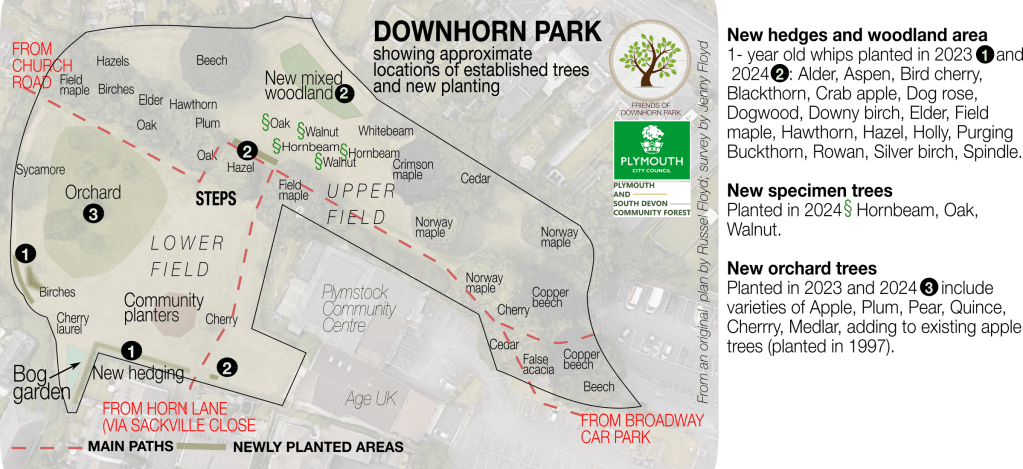
Hedge and Woodland Trees
Brief descriptions are mostly from the Woodland Trust website. Follow the links for more details.
Alder (Alnus glutinosa). Swamp-dweller, water-lover. The wood of this tough tree doesn’t rot when waterlogged, instead turning stronger and harder.
Aspen (Populus tremula). Trembling, fluttering and shimmering in the slightest breeze. The rippling leaves of this beautiful tree give it its name: quaking aspen.
Copper beech (Fagus sylvatica f. purpurea). Deep purple, distinctive, dramatic. The park contains several copper beeches these are ornamental cultivars of the native beech.
Dogwood (Cornus sanguinea). Understated until the colder months when it bursts into colour, dogwood is a broadleaf shrub which thrives in damp woodland edges. The timber is so hard, it was used for crucifixes.
Downy birch (Betula pubescens). Soft on the outside. Tough on the inside. On a global scale, this tree, with its fuzzy leaf stalks, shoots and twigs, grows further north than any other broadleaf species.
Elder (Sambucus nigra). Soft on the outside. Tough on the inside. On a global scale, this tree, with its fuzzy leaf stalks, shoots and twigs, grows further north than any other broadleaf species.
Bird cherry (Prunus padus). A stunning, scented show-stopper of a tree. In spring, nectar-loving animals flock to this beautiful tree for its almond-scented blossom.
Blackthorn (Prunus spinosa). Early to blossom, blackthorn trees have clouds of snow-white flowers in early spring. They’re best known for their rich, inky, dark fruits used to make a favourite wintry tipple – sloe gin.
Cedar (Cedrus libani). The park contains several cultivars of this majestic evergreen conifer.
Crab apple (Malus sylvestris). A symbol of fertility and a forager’s delight. Crab apple trees are associated with love and marriage and its small, hard fruits make an exquisite, jewel-coloured jelly.
Dog rose (Rosa canina). A familiar, scrambling beauty that adorns hedgerows with its pale pink flowers. Dog rose clasps on to other shrubs with curved spines to grow.
English oak (Quercus robur). The ruling majesty of the woods, the wise old English oak holds a special place in our culture, history, and hearts. It supports more life than any other native tree species in the UK; even its fallen leaves support biodiversity.
False acacia (Robin pseudoacacia). A fast-growing, spreading tree with rough bark and spines formed from stipules on twigs and suckers. The dark green leaves comprise 5-11 pairs of oval leaflets. Dense, drooping clusters of slightly scented white flowers in late spring and summer followed in autumn by oblong pods containing 4-10 seeds (poisonous!).
Field maple (Acer campestre). Pollution fighter, autumn stunner, syrup maker. The field maple is a sturdy broadleaf which supports caterpillars, aphids, and all their predators, all while resisting air pollution.
Hazel (Corylus avellana). Catkins resembling lambs tails, and late-summer nuts. Hazel is one of the most useful trees for its bendy stems and as a conservation saviour. And its nuts are loved by people, squirrels and hazel dormice.
Hawthorn (Crataegus monogyna). The pale green leaves of this hedgerow staple are often the first to appear in spring, with an explosion of pretty pale-pink blossom in May — a sign that spring is turning to summer. It simply teems with wildlife from bugs to birds.1/12
Holly (Ilex aquifolium). Festive, neat and prickly. Holly is a well-loved shrub that shelters birds and gives hedgehogs a cosy place to hibernate.
Hornbeam (Carpinus betulus). Gnarled and mighty, the hornbeam is as tough as they come. It’s beautiful, useful, and its year-round leaf cover makes it a winter haven for wildlife.1/11
Purging Buckthorn (Rhamnus cathartica). Named after the laxative effects its berries induce when eaten, purging buckthorn is a small, spiny tree native to England and Wales and throughout Europe. Mature trees can grow to a height of 10m.
Rowan (Sorbus aucuparia). Bane of witches, diviner of the future and producer of jam, rowan is an elegant tree with a mystical history. Its leaves and berries are a favourite for wildlife in woods and towns alike.
Silver Birch (Betula pendula). Pretty, pale, a symbol of purity. This common tree, with its silver-white bark, is favoured by gardeners who want to renew and purify their land for coming year.
Spindle (Euonymus europaeus). Industrious, delicate, colourful. The spindle is at its loveliest in autumn when its leaves turn russet and its pink and orange fruits ripen. Wildlife loves its leaves and fruit, and aphids flock to it, bringing with them an array of their predators.
Walnut (Juglans regia). Food of the gods, medicine for the people. Walnut was first introduced by the Romans who, like much of our native wildlife, valued its nuts.
Whitebeam (Sorbus aria). Charming and domestic, the whitebeam’s fruit is a favourite of garden birds. It’s rarely found in the wild but is a popular ornamental tree in parks and gardens, with lovely blossom and russet autumn leaves.
 Friends of Downhorn Park